Showing posts with label CS Lewis. Show all posts

Tuesday, October 6, 2015

Learning In War Time: CS Lewis


Learning in War-Time 
A sermon preached in the Church of St. Mary the Virgin, Oxford,Autumn, 1939  

A University is a society for the pursuit of learning. As students, you will be expected to make yourselves, or to start making yourselves, into what the Middle Ages called clerks: into philosophers, scientists, scholars, critics, or historians. And at first sight this seems to be an odd thing to do during a great war. What is the use of beginning a task which we have so little chance of finishing? Or, even if we ourselves should happen not to be interrupted by death or military service, why should we -- indeed how can we -- continue to take an interest in these placid occupations when the lives of our friends and the liberties of Europe are in the balance? Is it not like fiddling while Rome burns?

Now it seems to me that we shall not be able to answer these questions until we have put them by the side of certain other questions which every Christian ought to have asked himself in peace-time. I spoke just now of fiddling while Rome burns. But to a Christian, the true tragedy of Nero must be not that he fiddles while the city was on fire, but that he fiddles on the brink of hell. You must forgive me for the crude monosyllable. I know that many wiser and better Christians than I in these days do not like to mention heaven and hell, even in a pulpit. I know, too, that nearly all the references to this subject in the New Testament come from a single source. But then that source is Our Lord Himself. People will tell you it is St. Paul, but that is untrue. These overwhelming doctrines are dominical. They are not really removable from the teaching of Christ or of His Church. If we do not believe them, our presence in this church is great tomfoolery. If we do, we must sometime overcome our spiritual prudery and mention them. The moment we do so we can see that every Christian who comes to a university must at all times face a question compared with which the questions raised by the war are relatively unimportant. He must ask himself how it is right, or even psychologically possible, for creatures who are every moment advancing either to heaven or to hell, to spend any fraction of the little time allowed them in this world on such comparative trivialities as literature or art, mathematics or biology. If human culture can stand up to that, it can stand up to anything. 
 
To admit that we can retain our interest in learning under the shadow of these eternal issues, but not under the shadow of a European war, would be to admit that our ears are closed to the voice of reason and very wide open to the voice of our nerves and our mass emotions.  This indeed is the case with most of us: certainly with me. 

For that reason I think it important to try to see the present calamity in a true perspective: the war creates no absolutely new situation, it simply aggravates the permanent human situation so that we can no longer ignore it. Human life has always been lived on the edge of a precipice. Human culture has always had to exist under the shadow of something infinitely more important than itself. If men had postponed the search for knowledge and beauty until they were secure, the search would never have begun. 

We are mistaken when we compare war with "normal life". Life has never been normal. Even those periods which we think most tranquil, like the nineteenth century, turn out, on closer inspection, to be full of cries, alarms, difficulties, emergencies. Plausible reasons have never been lacking for putting off all merely cultural activities until some imminent danger has been averted or some crying injustice put right.

But humanity long ago chose to neglect those plausible reasons. They wanted knowledge and beauty now, and would not wait for the suitable moment that never come. Periclean Athens leaves us not only the Parthenon but, significantly, the Funeral Oration. The insects have chosen a different line: they have sought first the material welfare and security of the hive, and presumably they have their reward. Men are different. They propound mathematical theorems in beleaguered cities, conduct metaphysical arguments in condemned cells, make jokes on scaffold, discuss the last new poem while advancing to the walls of Quebec, and comb their hair at Thermopylae. This is not panache; it is our nature.

But since we are fallen creatures, the fact that this is now our nature would not, by itself, prove that it is rational or right. We have to inquire whether there is really any legitimate place for the activities of the scholar in a world such as this. That is, we have always to answer the question: "How can you be so frivolous and selfish as to think about anything but the salvation of human souls?" and we have, at the moment, to answer the additional question, "How can you be so frivolous and selfish as to think of anything but the war?" Now part of our answer will be the same for both questions. The one implies that our life can, and ought, to become exclusively and explicitly religious: the other, that it can and ought to become exclusively national. I believe that our whole life can, and indeed must, become religious in a sense to be explained later. 

But if it is meant that all our activities are to be of the kind that can be recognized as "sacred" and ties are to be of the kind that can be recognized as "sacred" and opposed to "secular" then I would give a single reply to both my imaginary assailants. I would say, "Whether it ought to happen or not, the thing you are recommending is not going to happen." 

Before I became a Christian I do not think I fully realized that one's life, after conversion, would inevitably consist in doing most of the same things one had been doing before: one hopes, in a new spirit, but still the same things. Before I went to the last war, I certainly expected that my life in the trenches would, in some mysterious sense, be all war. In fact, I found that the nearer you got to the front line the less everyone spoke and thought of the allied cause and the progress of the campaign; and I am pleased to find that Tolstoy, in the greatest war book ever written, records the same thing -- and so, in its own way, does the Iliad. Neither conversion nor enlistment in the army is really going to obliterate our human life. Christians and solders are still men: the infidel's idea of a religious life, and the civilian's idea of active service, are fantastic. If you attempted, in either case, to suspend your whole intellectual and aesthetic activity, you would only succeed in substituting a worse cultural life for a better. You are not, in fact, going to read nothing, either in the Church or in the line: if you don't read good books you will read bad ones. If you don't go on thinking rationally, you will think irrationally. If you reject aesthetic satisfactions you will fall into sensual satisfactions. There is therefore this analogy between the claims of our religion and the claims of the war: neither of them for most of us, will simply cancel or remove from the slate the merely human life which we were leading before we entered them. But they will operate in this way for different reasons.

The war will fail to absorb our whole attention because it is a finite object, and therefore intrinsically unfitted to support the whole attention of a human soul. In order to avoid misunderstanding I must here make a few distinctions. I believe our cause to be, as human causes go, very righteous, and I therefore believe it to be a duty to participate in this war. And every duty is a religious duty, and our obligation to perform every duty is therefore absolute. Thus we may have a duty to rescue a drowning man, and perhaps, if we live on a dangerous coast, to learn life-saving so as to be ready for any drowning man when he turns up. It may be our duty to lose our own lives in saving him. But if anyone devoted himself to life-saving in the sense of giving it his total attention --so that he thought and spoke of nothing else and demanded the cessation of all other human activities until everyone had learned to swim -- he would be a monomaniac. The rescue of drowning men is, then a duty worth dying for, but not worth living for. It seems to me that all political duties (among which I include military duties) are of this kind. A man may have to die for our country: but no man must, in any exclusive sense, live for his country. He who surrenders himself without reservation to the temporal claims of a nation, or a party, or a class is rendering to Caesar that which, of all things, most emphatically belongs to God: himself. 

It is for a very different reason that religion cannot occupy the whole of life in the sense of excluding all our natural activities. For, of course, in some sense, it must occupy the whole of life. There is no question of a compromise between the claims of God and the claims of culture, or politics, or anything else. God's claim is infinite and inexorable. You can refuse it: or you can begin to try to grant it. There is no middle way. Yet in spite of this it is clear that Christianity does not exclude any of the ordinary human activities. St. Paul tells people to get on with their jobs. He even assumes that Christians may go to dinner parties, and, what is more, dinner parties given by pagans. Our Lord attends a wedding and provides miraculous wine. Under the aegis of His Church, and in the most Christian ages, learning and the arts flourish. The solution of this paradox is, of course, well known to you. "Whether ye eat or drink or whatsoever ye do, do all to the glory of God." All our merely natural activities will be accepted, if they are offered to God, even the humblest: and all of them, even the noblest, will be sinful if they are not. Christianity does not simply replace our natural life and substitute a new one: it is rather a new organization which exploits, to its own supernatural ends, these natural materials. No doubt, in a given situation, it demands the surrender of some, or all, our merely human pursuits: it is better to be saved with one eye, than, having two, to be cast into Gehanna. But it does this, in a sense, per accidens -- because, in those special circumstances, it has ceased to be possible to practice this or that activity to the glory of God. There is no essential quarrel between the spiritual life and the human activities as such. Thus the omnipresence of obedience to God in a Christian's life is, in a way, analogous to the omnipresence of God in space. God does not fill space as a body fills it, in the sense that parts of Him are in different parts of space, excluding other object from them. Yet He is everywhere -- totally present at every point of space --according to good theologians.  

We are now in a position to answer the view that human culture is an inexcusable frivolity on the part of creatures loaded with such awful responsibilities as we. I reject at once an idea which lingers in the mind of some modern people that cultural activities are in their own right spiritual  and meritorious -- as though scholars and poets were intrinsically more pleasing to God than scavengers and bootblacks. I think it was Matthew Arnold who first used the English word spiritual in the sense of the German geistlich, and so inaugurated this most dangerous and most anti-Christian error. Let us clear it forever from our minds.The work of a Beethoven, and the work of a charwoman, become spiritual on precisely the same condition, that of being offered to God, of being done humbly "as to the Lord". This does not, of course, mean that it is for anyone a mere toss-up whether he should sweep rooms or compose symphonies. A mole must dig to the glory of God and a cock must crow. We are members of one body, but differentiated members, each with his own vocation. A man's upbringing, his talents, his circumstances, are usually a tolerable index of his vocation. If our parents have sent us to Oxford, if our country allows us to remain there, this is prima facie evidence that the life which we, at any rate, can best lead to the glory of God at present is the learned life.  By leading that life to the glory of God I do not, of course, mean any attempt to make our intellectual inquiries work out to edifying conclusions. That would be, as Bacon says, to offer to the author of truth the unclean sacrifice of a lie. I mean the pursuit of knowledge and beauty, in a sense, for their own sake, but in a sense which does not exclude their being for God's sake. An appetite for these things exists in the human mind, and God makes no appetite in vain. We can therefore pursue knowledge as such, and beauty as such, in the sure confidence that by so doing we are either advancing to the vision of God ourselves or indirectly helping others to do so. Humility, no less than the appetite, encourages us to concentrate simply on the knowledge or the beauty, not too much concerning ourselves with their ultimate relevance to the vision of God. That relevance may not be intended for us but for our betters -- for men who come after and find the spiritual significance of what we dug out in blind and humble obedience to our vocation. This is the teleological argument that the existence of the impulse and the faculty prove that they must have a proper function in God's scheme -- the argument by which Thomas Aquinas probes that sexuality would have existed even without the Fall. The soundness of the argument, as regards culture, is proved by experience. The intellectual life is not the only road to God, nor the safest, but we find it to be *a* road, and it may be the appointed road for us. Of course it will be so only so long as we keep the impulse pure and disinterested. That is the great difficulty. As the author of the Theologia Germanicai says, we may come to love knowledge -- our knowing -- more than the thing known: to delight not in the exercise of our talents but in the fact that they are ours, or even in the reputation they bring us. Every success in the scholar's life increases this danger. If it becomes irresistible, he must give up his scholarly work. The time for plucking our the right eye has arrived.  That is the essential nature of the learned life as I see it. But it has indirect values which are especially important to-day. If all the world were Christian, it might not matter if all the world were uneducated. But, as it is, a cultural life will exist outside the Church whether it exists inside or not. To be ignorant and simple now -- not to be able to meet the enemies on their own ground -- would be to throw down our weapons, and to betray our uneducated brethren who have, under God, no defense but us against the intellectual attacks of the heathen. Good philosophy must exist, if for no other reason, because bad philosophy needs to be answered. The cool intellect must work not only against cool intellect on the other side, but against the muddy heathen mysticisms which deny intellect altogether.  Most of all, perhaps we need intimate knowledge of the past. Not that the past has any magic about it, but because we cannot study the future, and yet need something to set against the present, to remind us that periods and that much which seems certain to the uneducated is merely temporary fashion. A man who has lived in many place is not likely to be deceived by the local errors of his native village: the scholar has lived in many times and is therefore in some degree immune form the great cataract of nonsense that pours from the press and the microphone of his own age. 

The learned life then is, for some, a duty. At the moment, it looks as if it were *your* duty. I am well aware that there may seem to be an almost comic discrepancy between the high issues we have been considering and the immediate task you may be set down to, such as Anglo-Saxon sound laws or chemical formulae. But there is a similar shock awaiting us in every vocation -- a young priest finds himself involved in choir treats and a young subaltern in accounting for pots of jam. It is well that it should be so. It weeds out the vain, windy people and keeps in those who are both humble and tough. On that kind of difficulty we need waste no sympathy.  But the peculiar difficulty imposed on you by the war is another matter: and of it I would again repeat, what I have been saying in one form or another ever since I started -- do not let your nerves and emotions lead you into thinking your present predicament more abnormal than it really is.

Perhaps it may be useful to mention the three mental exercises which may serve as defenses against the three enemies which war raises up against the scholar. The first enemy is excitement -- the tendency to think and feel about the war when we had intended to think about our work. The best defense is a recognition that in this, as in everything else, the war has not really raised up a new enemy but only aggravated an old one. There are always plenty of rivals to our work. We are always falling in love or quarreling, looking for jobs or fearing to lose them, getting ill and recovering, following public affairs. If we let ourselves, we shall always be waiting for some distraction or other to end before we can really get down to our work. The only people who achieve much are those who want knowledge so badly that they seek it while the conditions are still unfavorable. Favourable conditions never come. There are, of course, moments when the pressure of the excitement is so great that any superhuman self-control could not resist it. They come both in war and peace. We must do the best we can. 

The second enemy is frustration -- the feeling that we shall not have time to finish. If I say to you that no one has time to finish, that the longest human life leaves a man, in any branch of learning, a beginner, I shall seem to you to be saying something quite academic and theoretical. You would be surprised if you knew how soon one begins to feel the shortness of the tether: of how many things, even in middle life, we have to say "No time for that", "Too late now", and "Not for me". But Nature herself forbids you to share that experience. A more Christian attitude, which can be attained at any age is that of leaving futurity in God's hands. We may as well, for God will certainly retain it whether we leave it to Him or not. Never, in peace or war, commit your virtue or your happiness to the future. Happy work is best done by the man who take his long-term plans somewhat lightly and woks from moment to moment "as to the Lord". It is only our daily bread that we are encourage to ask for. The present is the only time in which any duty can be done or any grace received. 

The third enemy is fear. War threatens us with death and pain. No man -- and specially no Christian who remembers Gethsemane -- need try to attain a stoic indifference about these things: but we can guard against the illusions of the imagination. We think of the streets of Warsaw and contrast the deaths there suffered with an abstraction called Life. But there is no question of death or life for any of us; only a question of this death or of that -- of a machine gun bullet now or a cancer forty years later. What does war do to death? It certainly does not make it more frequent; 100 per cent of us die, and the percentage cannot be increased. It puts several  deaths earlier; but I hardly suppose that that is what we fear. Certainly when the moment comes, it will make little difference how many years we have behind us. Does it increase our chance of a painful death? I doubt it. As far as I can find out, what we call natural death is usually preceded by suffering; and a battlefield is one of the very few places where one has a reasonable prospect of dying with no pain at all. Does it decrease our chances of dying at peace with God? I cannot believe it. If active service does not persuade a man to prepare for death, what conceivable concatenation of circumstance would? Yet war does do something to death. It forces us to remember it. The only reason why the cancer at sixty or the paralysis at seventy-five do not bother us is that we forget them. War makes death real to us: and that would have been regarded as one of its blessings by most of the great Christians of the past. They thought it good for us to be always aware of our mortality. I am inclined to think they were right.  All the animal life in us, all schemes of happiness that centered in this world, were always doomed to a final frustration. In ordinary times only a wise man can realize it. Now the stupidest of us know. We see unmistakable the sort of universe in which we have all along been living, and must come to terms with it. If we had foolish un-Christian hopes about human culture, they are now shattered. If we thought we were building up a heaven on earth, if we looked for something that would turn the present world from a place of pilgrimage into a permanent city satisfying the soul of man, we are disillusioned, and not a moment too soon. But if we thought that for some souls, and at some times, the life of learning, humbly offered to God, was, in its own small way, one of the appointed approaches to the Divine reality and the Divine beauty which we hope to enjoy hereafter, we can think so still.

Friday, May 2, 2014

The Soul's Secret Signature


“Even in your hobbies, has there not always been some secret attraction which the others are curiously ignorant of--something, not to be identified with, but always on the verge of breaking through, the smell of cut wood in the workshop or the clap-clap of water against the boat's side? Are not all lifelong friendships born at the moment when at last you meet another human being who has some inkling (but faint and uncertain even in the best
) of that something which you were born desiring, and which, beneath the flux of other desires and in all the momentary silences between the louder passions, night and day, year by year, from childhood to old age, you are looking for, watching for, listening for? You have never had it. All the things that have ever deeply possessed your soul have been but hints of it--tantalizing glimpses, promises never quite fulfilled, echoes that died away just as they caught your ear. But if it should really become manifest--if there ever came an echo that did not die away but swelled into the sound itself--you would know it. Beyond all possibility of doubt you would say 'Here at last is the thing I was made for.' We cannot tell each other about it. It is the secret signature of each soul, the incommunicable and unappeasable want, the things we desired before we met our wives or made our friends or chose our work, and which we shall still desire on our deathbeds, when the mind no longer knows wife or friend or work. While we are, this is. If we lose this, we lose all.”  --CS Lewis, The Problem of Pain

Tuesday, April 16, 2013

Grati-Tuesday

I am thankful for the internet.  Yes...it can be a bottomless pit of time wasting, but for every minute I've wasted, I've been  encouraged and blessed by Sisters whom I haven't seen for years, Sisters whom I see regularly, and even by Sisters whom I've never met.   This article is an example of the latter.   Is it not a great gift to be blessed by an honest, godly perspective that resonates with your own heart and mind?  It certainly is for me.  I'm thankful for those women who take the time to share their hearts as well as for those who pass along these little gems.  We need one another.

http://www.storywarren.com/on-loneliness-a-letter-to-my-children/

I wish I could remember how many times your father has read the Narnia books to you. During those slow years when you still had time to crawl up into a lap and listen, you spent hundreds of hours in the company of Caspian, Lucy, Jill, and Reepicheep.

We read those books until the fabric of that world integrated with the fabric of our own. When we ate a good breakfast, we declared it a centaur breakfast. A thick, white snow was a Narnian snow. That awful kid at school was a Eustace. When your dad and I grew weary, we would crawl under our covers at night and remind ourselves of the fatigue of little Shasta running in the woods.

There are so many ways we have watched our own lives unfolding through the lens Lewis provided; yet there is one particular Narnian theme that tends to recur more than any other in my life. It is a thing so subtle, it is rarely addressed openly in the stories; yet somehow I sense it in all of them. That theme is loneliness.

By loneliness, I do not mean friendlessness, for loneliness and friendlessness are not the same.  Most of life will give you a friend or two somewhere or other. What I mean is that there is sort of loneliness that exists even among friends, among brothers and sisters, even in a world where Aslan appears and disappears in the checkered shade. Among good things, among good people, among warm food and bright rooms there are still those of us who live with a sense that somehow something is missing.

When I was a child, I believed that the remedy for this ache was a proper friendship. In my third grade class there was a flurry of silly little girls volleying over one another. We all wanted the sort of companion who could share our giggles, and our secret words, and our subtle meanings. Once we found her we could form an alliance so tight, the world would never hurt us. But it never quite worked like this. I found people to love, but I never found the one I was looking for.

As I grew older, I believed romance was the answer. I began to look for a dark-eyed young man with a hearty vocabulary who knew how to make music and interesting things out of wood. I wanted a student of my heart, a dreamer, a thinker,  a guardian to protect my softness from every dragon of the night.  Searching for this, I fell in, and out, and in, and out of love. I learned that romance cooled and warmed again like the seasons.  I learned that no one person, no matter how perfect, could remedy every lack.

Young motherhood arrived with all of its glory and confusion. I looked for pilgrims to share this adventure with me, a few sweet hens with new chicks. We exchanged moments of camaraderie, organizing play dates and doing our best to share life together. Yet there was a severe isolation to those days we all spent at home, and when we finally came together, we were starved for praise and affection. Inside our own little walls, we had been grunting out different philosophies, walking in our lack until we couldn’t help but compete for affirmation here and there. Also, our kids slowly grew old enough to annoy one another, and we all seemed to have different solutions for that problem. There was a collective sigh of relief when the time came to send you all to different schools, because life in the close had grown more awkward than life apart.

Some of us stretched out into the larger Christian community. There were beautiful elements to that, elements of nurture and warmth that I enjoy to this day. Life is busy, though. From what I can tell, most of us are focused on simply surviving. When I am at church, I see faces that look interesting to me, faces I would like to know more. Yet there is hardly time to sleep, let alone mingle. So we wave, and we smile, standing two feet away and twenty miles apart.

At some point, I began to take my loneliness into niches of thinkers who share my creative interests. In these exchanges, I found brilliant moments of resonance, flashes of what I’ve always thought community could be like. I don’t know when I have ever felt so alive. But those moments do not happen every day, they are rare and they are sacred. Furthermore, even in creative community, there can be misunderstanding. Sometimes foundational beliefs don’t align. There are time barriers, societal barriers, emotional barriers, and even jealousy. We have weaknesses that wound one another. We live too far from those who fill us. Even where it seems all could be well, and that all should be well, all isn’t well. Not always.

I suppose there are people in the world who never feel this sort of unsettledness. Maybe they have grown up in small, idyllic towns among the insightful and tender. Maybe God gives a Jonathan a David here and there, even yet.

Or perhaps there are certain souls who don’t desire the same level of resonance that I do. From what I can tell, some people are quite content to never chase questions or creations, and I am not sure whether to envy them or doubt them.

But for those who are wired like we are (because I believe you and I are at least similar in this), I think every Lucy is likely to find herself standing alone now and then. Even though Susan, Edmund, and Peter wait nearby – they cannot hear that singular call of Aslan. And sometimes she stands in the wood alone and without even hearing the Lion. There are days when we walk among friends, without any friends at all.

As I think about the sort of man Lewis was and imagine what a unique burden it must have been to live with such a capacity of mind and heart, I wonder what the exact shape of his loneliness was. I don’t see how the sorts of things he made could have been made without this longing being present. (Or perhaps I am projecting, because most of the beautiful things I have ever made have come from it.)

Regardless, what I most want you to know is that loneliness doesn’t mean something is wrong with you. Instead, it is a training ground.

Of course loneliness will be difficult. Within every training ground, there are a thousand opportunities to be wounded. For instance, feeling alone might tempt you to grow cynical. It might cause you feel so desperate and restless that you try to get your needs met in ways that you know could be harmful to yourself or others.

Loneliness might make you afraid to do what you know you must, because doing hard things is so much harder when you have no one cheering. It might make you doubt yourself when you should not. It might even make you hate yourself.

It might make you so impatient for resolution that you choose a lesser answer too quickly. It might make you want to impress people who have labels, or who seem to be settled, or who are beautiful. I suppose it could even tempt you to take such a strong stand against a broken thing that you live reactively instead of proactively.

Each one of these possibilities is terribly dangerous and terribly beneficial, because in every inclination you will be refined. In every inclination you will see how you are defined.

So far I have mentioned only the gap between men, but there is something harder still. I do not fully understand why God seems to choose silence so often, but the loneliness we feel on earth between our peers is only a shadow of a more primary ache.

It is not that God doesn’t commune with man, but He does tend to meet with us in a way that transcends our daily vernacular. We have been taught to engage with cold milk and mathematics. We are not accustomed to listening with ears of the Spirit.  We want God to be tactile in the exact same way that we want men to be tactile.

It is my suspicion that the filling of this tactile desire might be the first joy of Heaven. For now, though, we spend days like pilgrims walking in a cave, listening to our own hearts pounding, listening to the threads of our own ears brushing against one another.

In private, we cry out for God to be closer  – though if you asked us, we would tell you that we believe He is already as close as our own hearts. We say we believe, and yet we are ashamed that such a mighty hunger remains, and that we long to place our cold fingers in the wounds of a warm hand to confirm (at last) what we claim not to doubt but sometimes do despite ourselves. Because sometimes God feels close. And sometimes He feels so very far away.

I tell you, I would cling to those flesh ankles as they were ascending to heaven, because that thing called death is ever so much easier than faith. There are different dimensions in this world, some named and some not, and our senses for some are stronger than others. There are things I know from a spirit I cannot show you, things I would die for but cannot hold between my hands.

Which means this is a hard thing we do. And yet, this ache is not nearly as bleak as it seems. Here is why.
Long ago, wise men would journey into the desert to find wisdom. They did this because they sensed a great secret – that want is a greenhouse for revelation. Hunger cleanses. It makes us ready. And loneliness, as hard as it is, is a sort of hunger. It grows a heightened awareness in us, burns away the dross, primes us, shows us our weakness.

Loneliness forces us into the presence of the soundless symphony of the Divine, so that we might learn to hear the songs of a distant land. It stretches us larger so that we might have more room for a God the world has painted far too small. It shows us an ache the size of the heavens, an ache that was given to be filled.

So I hope you will not be too afraid or too surprised when it comes to you. I have lived with this a good long while now, and I am starting to see that there is a need for Shasta to run for a night, exhausted, cold, and friendless. I am starting to see that there is growth in the falling heart of Lucy when no one believes what she has heard whispered, not even herself. I am starting to understand why solitary Edmund wavers, and why Reepicheep points his nose East at all costs, and how this terrible want that keeps me awake (night, after night, after night) will be met one day when my desire has grown not smaller, but large enough to burst the tiny cage the men of earth have built for the containment of a ridiculously-tiny lion.

Our wants are not too great, but too small. So, do not fear. There is an answer for the sadness in you, though you will only find it a bit at a time. Without it, you are wise to be a bit unsettled. Be content. Be also ravenous. What you long for is here already. What you long for is coming still.

Thursday, January 7, 2010

Unmasked & Unmade

My son, Grant, was 13 when he first read Lewis' tale, Till We Have Faces...and he promptly declared it to be "the best book I've ever read!"  From a child who had already devoured Chesterton, Tolkien, Stevenson, Homer, Austen and Orwell, this was a weighty endorsement.  I knew I had to read it.  That was 3 years ago!

When I picked it up again last Friday, it marked my third attempt to engage with the story.  I've had that experience before...with rather insignificant works such as The Hobbit, Les Miserables, and The Count of Monte Cristo, all of which became favorites of mine once I finally read them!  Some books require the right frame of mind before they can be taken in.   So...once again, I started at the very beginning (a very good place to start) and this time my imagination was immediately drawn in.

However, I was continually plagued by a distinct and unsettling awareness that there was more going on than I could grasp.  I was very unsure how to rightly interpret characters and events.  "What does all this really mean?"  I feared reaching the end without understanding or resolution. 

But then...ah, then!...came Book II!  I know. I understand.  I get it. 

Once again, beyond all reason, Lewis has masterfully crafted a story which knocks a man's heart out by its transmission of profound truth - truth that cannot be sufficiently ascertained through maxims and doctrinal statements, but which pierces, penetrates, and permeates the soul.

Really.  It's that good. 

Though I readily admit that this story defies explanation - it must be experienced - it won't surprise you that I will attempt to articulate a couple of its truths anyway.  Trust me when I say that the power of these truths is magnified a hundredfold by reading the story itself, and my remarks are only intended to solidify those truths in my own mind and to move you to "take up and read!"

OK...nevermind!  After laboring for several hours, I find I cannot adequately summarize the central truths of this story!  So, I'll leave it at this:

In the end, we must have our faces unveiled and be utterly exposed...before ourselves and everyone else.  We then see in our own face all the ugliness which we previously thought was around us, in everyone else, and imposed by the often-silent and uncaring Deity.  This unmasking brings to light our motives, the failure of our perceived successes, and our self-absorbed misinterpretation of our own and other's lives.  Only after we see ourselves rightly and are unmade by what we see, can we be made new and given faces that are beautiful and radiant.  From death comes true life...

That is a very weak summary, but the best I can do!  READ THE BOOK!!  You won't be sorry...promise.

Thursday, November 12, 2009

It Quite O'ercrows My Spirit

Helpful quotes from Lewis's book, The Problem of Pain:

All arguments in justification of suffering provoke bitter resentment against the author. You would like to know how I behave when I am experiencing pain, not writing books about it. You need not guess, for I will tell you; I am a great coward. When I think of pain - of anxiety that gnaws like fire and loneliness that spreads out like a desert, and the heartbreaking routine of monotonous misery, or again of dull aches that blacken our whole landscape or sudden nauseating pains that knock a man's heart out at one blow, of pains that seem already intolerable and then are suddenly increased, it 'quite o'ercrows my spirit'. If I knew any way of escape I would crawl through sewers to find it. But what is the good of telling you about my feelings? You know them already: they are the same as yours. I am not arguing that pain is not painful. Pain hurts. That is what the word means. I am only trying to show that the old Christian doctrine of being made 'perfect through suffering' is not incredible. To prove it palatable is beyond my design.

My own experience is something like this. I am progressing along the path of life in my ordinary contentedly fallen and godless condition, absorbed in a merry meeting with my friends for the morrow or a bit of work that tickles my vanity today, a holiday or a new book, when suddenly a stab of abdominal pain that threatens serious disease, or a headline in the newspapers that threatens us all with destruction, sends this whole pack of cards tumbling down. At first I am overwhelmed, and all my little happinesses look like broken toys. Then, slowly and reluctantly, bit by bit, I try to bring myself into the frame of mind that I should be in at all times. I remind myself that all these toys were never intended to possess my heart, that my true good is in another world and my only real treasure is Christ. And perhaps, by God's grace, I succeed, and for a day or two become a creature consciously dependent on God and drawing its strength from the right sources. But the moment the threat is withdrawn, my whole nature leaps back to the toys: I am even anxious, God forgive me, to banish from my mind the only thing that supported me under the threat because it is now associated with the misery of those few days. Thus the terrible necessity of tribulation is only too clear. God has had me for but forty-eight hours and then only by dint of taking everything else away from me. Let Him but sheathe that sword for a moment and I behave like a puppy when the hated bath is over - I shake myself as dry as I can and race off to reacquire my comfortable dirtiness, if not in the nearest manure heap, at least in the nearest flower bed. And that is why tribulation cannot cease until God either sees us remade or sees that our remaking is now hopeless.

May He see us remade!

And...May we believe that the sufferings of this present life are not worthy to be compared to the glory which will be revealed in us one day.

Thursday, June 25, 2009

A Grief Observed

C.S. Lewis's true love came to him late in life in the person of Joy Gresham and though they had only been married for 4 years when she lost her battle with cancer, he was deeply and permanently affected. Only the hardest of hearts could not be moved by the thoughts and emotions he conveys in this brief journal. Though its brevity makes for a quick and easy read, it is nevertheless a profound and soul-stirring account of one man's journey of faith through a dark valley.

Feelings, and feelings, and feelings. Let me try thinking instead. From the rational point of view, what new factor had H.'s death introduced into the problem of the universe? What grounds has it given me for doubting all that I believe? I knew already that these things, and worse, happened daily. I would have said that I had taken them into account. I had been warned - I had warned myself - not to reckon on worldly happiness. We were even promised sufferings. They were a part of the program. We were even told, "Blessed are they that mourn," and I accepted it. I've got nothing that I hadn't bargained for. Of course it is different when the thing happens to oneself, not to others, and in reality, not in imagination. Yes; but should it, for a sane man, make quite such a difference as this? No. And it wouldn't for a man whose faith and whose concern for other people's sorrows had been real concern. The case is too plain. If my house has collapsed at one blow, that is because it was a house of cards. The faith which "took these things into account" was not faith but imagination. The taking them into account was not real sympathy. If I had really cared, as I thought I did, about the sorrows of the world, I should not have been so overwhelmed when my own sorrow came. It has been an imaginary faith playing with innocuous concerns labelled "Illness," "Pain," "Death," and "Loneliness." I thought I trusted the rope until it mattered to me whether it would bear me. Now it matters, and I find I didn't.

Lewis doesn't remain in this doubt forever. He eventually comes to terms with Joy's death and his sorrow and he admits:

God has not been trying an experiment on my faith or love in order to find out their quality. He knew it already. It was I who didn't. In this trial, He makes us occupy the dock, the witness box, and the bench all at once He always knew that my temple was a house of cards. His only way of making me realize the fact, was to knock it down.

His return to a place of faith doesn't happen through some earth-shattering, dramatic, conversion-like experience, but rather like the warming of a room or the coming of daylight. When you first notice them, they have already been going on for some time.

A Grief Observed will only consume a mere 2-3 hours of your time and is more than worth that amount. If you haven't already, take the time to read it!

Tuesday, May 20, 2008

Prince Caspian

Yes, I reviewed the movie in the previous post, but I also read the book for the first time earlier this week and wanted to record some of my favorite lines/passages from it. No profound commentary or anything, just quotes. I wasn't totally crazy about A Horse and His Boy, so I wasn't sure what I would think about Prince Caspian, but it rates right up there with The Lion, the Witch and the Wardrobe!

---------------------------------------------------------

The dwarf Nikabrik is very suspicious of Caspian when they find him injured in the woods, because he doesn't trust humans. He complains to the others that no good will come of his presence.

"Don't you go talking about things you don't understand, Nikabrik," said Trufflehunter. "You Dwarfs are as forgetful and changeable as the Humans themselves. I'm a beast, I am, and a Badger what's more. We don't change. We hold on. I say great good will come of it. This is the true King of Narnia we've got here: a true King, coming back to true Narnia. And we beasts remember, even if Dwarfs forget, that Narnia was never right except when a son of Adam was King."

-----------------------------------------------------------
Lucy's first encounter with Aslan on this particular trip to Narnia goes like this:

"Welcome, child," he said.

"Aslan, said Lucy, "you're bigger."

"That is because you are older, little one," answered he.

"Not because you are?"

"I am not. But every year you grow, you will find me bigger."

-------------------------------------------------------------
Lucy receives her commission from Aslan, but is disappointed that he hasn't set everything right already. Her complaint sounds somewhat familiar, don't you think? "And I thought you'd come roaring in and frighten all the enemies away..."

-------------------------------------------------------------
When Peter and Edmund go off to war leaving the girls behind with Aslan, the trees begin to dance and there appear a wild and handsome young boy and several maidens, followed by laughing, shouting, games, and feasting! This is how they spend their time in Aslan's presence even as the men head out to fight. When they stop celebrating, Lucy realizes that the boy was Bacchus - the Roman god of wine. Susan's response is, "I say, Lu, I wouldn't have felt safe with Bacchus and all his wild girls if we'd met them without Aslan." To which Lucy responds, "I should think not!"

Saturday, May 17, 2008

Beauty and Brilliance

Though the title might lead you to believe otherwise, this post is actually not about ME. But thanks...it was a nice thought.

The boys, Riesa, and I ventured out to see Prince Caspian yesterday afternoon. And, trust me, when anyone over 30 heads to Ronnie's 20 on a Friday, it qualifies as a "venture" (i.e. a risky or dangerous undertaking). As is usually the case with movies "based" on books, PC was less than satisfying. It was even less true to the book than the first Narnia movie and took greater liberties than I had expected with Mr. Gresham at the helm.

The scenery was stunning, the battles intense, and the creatures realistic, but they focused too heavily on these features and the story suffered as a result. The complusion to add to and even distort the original storyline leads me to believe the script writers must not fully appreciate the beauty and brilliance of Lewis' narrative.

Lewis' gentle cadence and rather-unadorned appeals to the imagination arouse in me a childlike delight and sense of wonder, while his artful weaving of Biblical symbolism, imagery, and theology bring to mind beautiful and profound truths. These qualities combine in a unique way in Lewis. Beatrix Potter writes with a similar gentle cadence, A.A. Milne evokes the childlike delight, Tolkien weaves the imagery, but none of these - for me anyway - incorporate them all to the effect that Lewis does.

When the cadence and profound simplicity are removed, as they are in the movie, the story only marginally resembles the original. The imitation is good, but the original is a masterpiece.

Tuesday, March 18, 2008

The Heavens

The image of God manifest in man's ingenuity, makes images and accomplishments such as these aaccessible! The first 2 photos are from Endeavor's most recent launch:

These next images were featured this month at NASA's "Astronomy Picture of the Day" site and they add significance to the following passage from C.S. Lewis' Out of the Silent Planet:

Ransom became aware of another and more spiritual cause for his progressive lightening and exultation of heart. A nightmare, long engendered in the modern mind by the mythology that follows in the wake of science, was falling off him. He had read of "Space": at the back of his thinking for years had lurked the dismal fancy of the black, cold vacuity, the utter deadness which was supposed to separate the worlds. He had not known how much it affected him till now - now the very name "Space" seemed a blasphemous libel for this empyrean ocean of radiance in which they swam....No: space was the wrong name. Older thinkers had been wiser when they named it simply "the Heavens."

Wednesday, January 23, 2008

Theology for Children

Pauline Baynes, Lewis' original illustrator, beautifully captured the essence of his stories, but I really love the more-recent, lush illustrations which Deborah Maze created for an adaptation of The Lion, the Witch and the Wardrobe (I'm not crazy about the adaptation itself...although it is not badly done, I simply view it as superfluous. Any child who can hear and understand the adaptation, can hear and understand the original in all its depth and delight.)

Here are a few of Maze's illustrations, paired with passages from the book and from Scripture. I continue to be amazed at the extensive theology which Lewis incorporated into all his fictional works. Even though he often downplayed the intentionality of it, the fact remains that nearly every detail is saturated with biblical truth.
------------------------------------------------------------
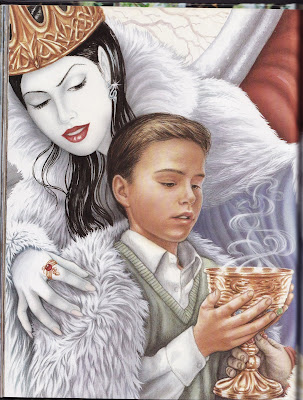
The evil Queen of Narnia, clothed in white garments, is disguised as an angel of light, who tempts Edmund through food, flattery and the promise to rule. Echoes of the serpent in the Garden as well as Solomon's portrayal of Lady Folly are inescapable.

"It is a lovely place, my house," said the Queen. "I am sure you would like it. There are whole rooms full of Turkish Delight, and what's more, I have no children of my own. I want a nice boy whom I could bring up as a Prince and who would be King of Narnia when I am gone. While he was Prince he would wear a gold crown and eat Turkish Delight all day long; and you are much the cleverest and handsomest young man I've ever met. I think I would like to make you Prince - some day, when you bring the others to visit me." (Chapter 4, Turkish Delight) 

With her many persuasions she entices him, with her flattering lips she seduces him. He follows her as an ox to the slaughter, until an arrow pierces through his liver; so he does not know that it will cost him his life. (Proverbs 7:21-23) 
------------------------------------------------------------


In this section, we see what happens when a new king comes to rule...he sends gifts to his loyal subjects...that's what kings do! Father Christmas, as Aslan's ambassador, distributes gifts "to each one individually just as He wills." He equips each of them to fulfill their purpose in restoring the kingdom. "When Christ ascended on high, he led captivity captive and gave gifts to men." Upon his ascension to the throne, Christ, by his Spirit, distributes various gifts: "...to each one is given the manifestation of the Spirit for the common good." (I Corinthians 12)


"Come on!" cried Mr Beaver, who was almost dancing with delight. "Come and see! This is a nasty knock for the Witch! It looks as if her power is already crumbling. Didn't I tell you that she'd made it always winter and never Christmas? Well, just come and see!"


And then they did see.


It was a sledge, and it was reindeer with bells on their harness...and on the sledge sat...a huge man in a bright red robe...Father Christmas.


"I've come at last,' said he. "She has kept me out for a long time, but I have got in at last. Aslan is on the move. The Witch's magic is weakening." (Chapter 10)

Father Christmas gives the children their gifts, instructs them in their proper use, and advises them to "Bear them well."
-----------------------------------------------------------


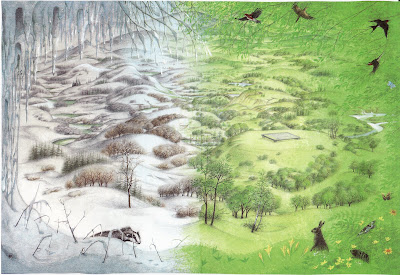
(This illustration is Baynes')
"Every moment the patches of green grew bigger and the patches of snow grew smaller. Every moment more and more of the trees shook off their robes of snow. Soon, wherever you looked, instead of white shapes you saw the dark green of firs or the black prickly branches of bare oaks and beeches and elms. Then the mist turned from white to gold and presently cleared away altogether. Shafts of delicious sunlight struck down onto the forest floor and overhead you could see a blue sky between the tree tops. The sky became bluer and bluer, and now there were white clouds hurrying across it from time to time. In the wide glade were primroses. A light breeze sprang up and carried cool, delicious scents. A bee buzzed across their path. "This is not a thaw," said the dwarf, suddenly stopping. "This is Spring!" (Chapter 11)

He changes a wilderness into a pool of water and a desolate land into springs of water...give thanks to Yahweh for His lovingkindness. Psalm 107:35
-----------------------------------------------------------
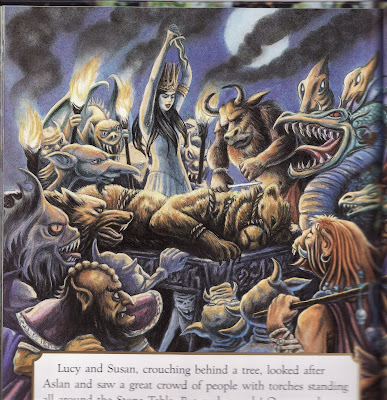
Edmund, through his treachery and betrayal, has become the Queen's "lawful prey" whom she has a "right to kill." "His life is forfeit to me. His blood is my property." Aslan offers his blood and life as a substitute...the Queen is filled with fierce joy.

"And now who has won? Fool! Did you think by all of this that you would save the human traitor? Now I will kill you instead of him. But when you are dead, what will prevent me from killing him as well? And who will take him out of my hand then? You have lost your own life and you have not saved his. In that knowledge, despair and die." (The White Witch in Chapter 14)

And while being reviled, he did not revile in return; while suffering, he uttered no threats, but kept entrusting himself to the One who judges righteously...by his wounds you were healed. (I Peter 2:23-25)
-----------------------------------------------------------
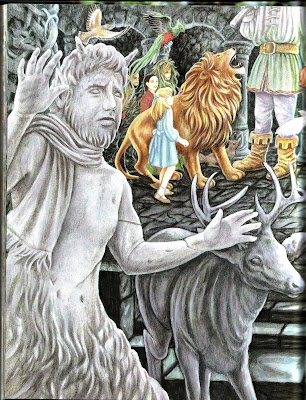
[Aslan] bounded up to the stone lion and breathed on him...Everywhere statues were coming to life. The courtyard no longer looked like a museum; it looked more like a zoo...and instead of the deadly silence, the whole place rang with the sound of happy roarings...songs and laughter. (Chapter 16)

Behold, I will cause breath to enter you that you may come to life. And I will put sinews on you, make flesh grow back on you, cover you with skin, and put breath in you that you may come alive; and you will know that I am Yahweh." (Ezekiel 37:5-6)
-----------------------------------------------------------
When Adam's flesh and Adam's bone
Sits at Cair Paravel in throne,
The evil time will be over and done.


Once a king or queen in Narnia, always a king or queen.
Bear it well, Sons of Adam!
Bear it well, Daughters of Eve!

And there shall no longer be any curse...and they shall not have need of the light of a lamp not the light of the sun, because the Lord God shall illumine them; and they shall reign with him forever and ever. (Revelation 22: 3-5)